
By John Gittelsohn and Michelle Ma
Photographs and video by Elizabeth Weinberg
January 7, 2025 at 8:00 AM EST
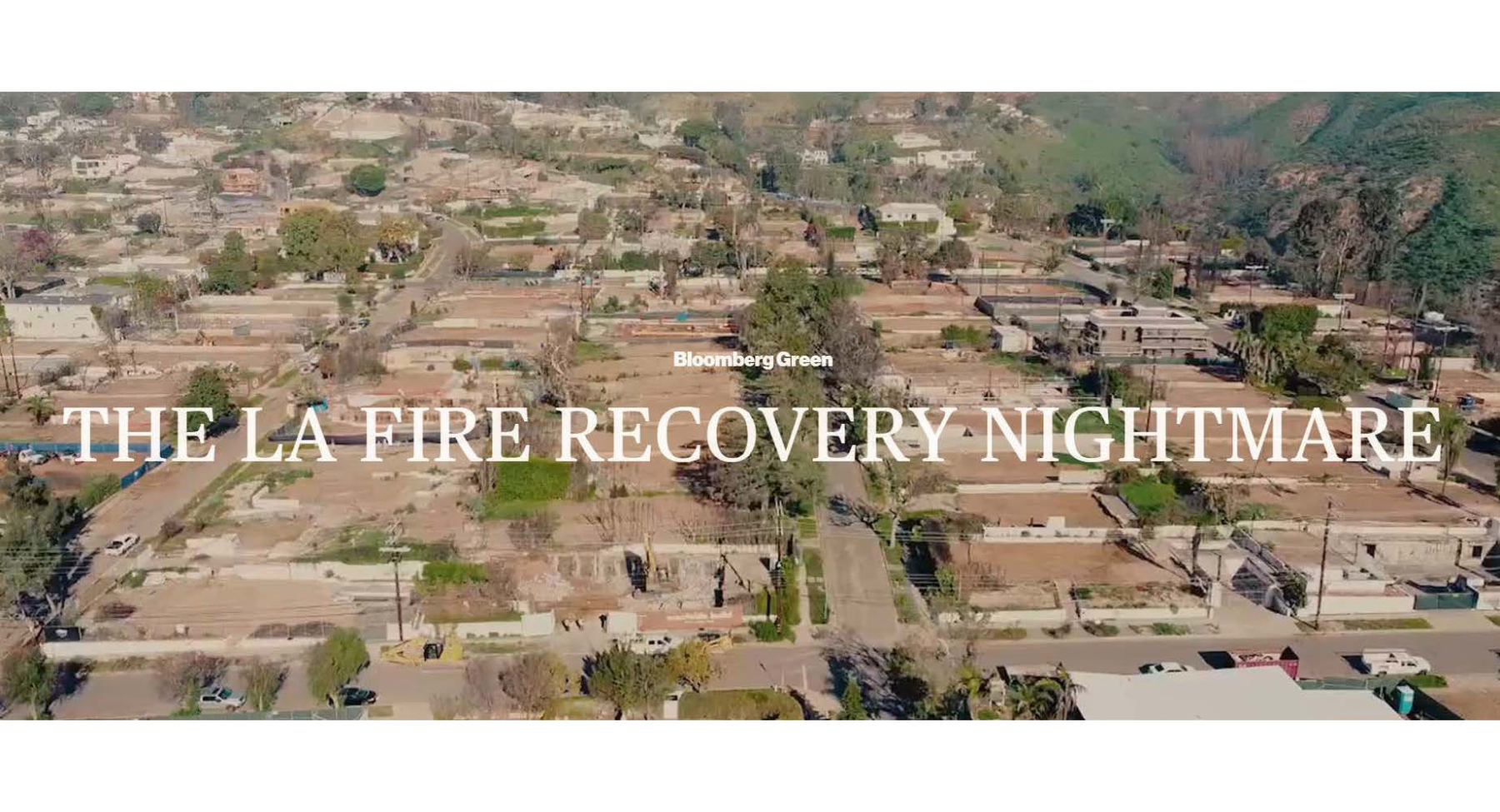
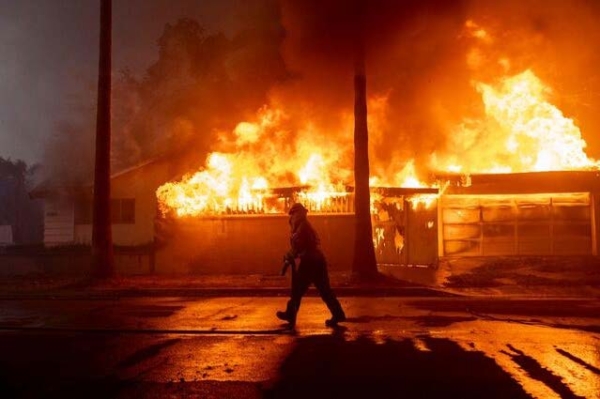
As an inferno roared toward her California home last January, Pauline Ching didn’t have time to grab family photos or her Chinese jade and ivory antiques. The house where she had raised her children and welcomed grandchildren soon became a statistic: one of more than 16,000 structures destroyed in the costliest wildfires in US history.
A year on, Ching is among the first homeowners to begin rebuilding in Altadena, the Los Angeles suburb ravaged by the Eaton Fire. She persuaded almost half of the 54 homeowners in her gated community to hire a single contractor, securing bulk discounts and faster permit approvals out of reach for many neighbors.
Still, the rebuild will cost Ching about $350,000 more than her insurance will cover. To close the gap, she has joined a class-action lawsuit against utility Southern California Edison, whose power line is suspected to have sparked the blaze.
“My situation is better than a lot of others,” Ching, 69, said from the home of her 96-year-old mother, where she’s staying while awaiting her house’s completion. “But once I got to the bottom line, I saw it costs a lot more than my insurance is covering. And there are things I lost that you can’t put a price on.”

Ching’s experience captures the difficult reality of LA’s fire recovery one year after the Eaton and Palisades blazes killed 31 people and charred almost 40,000 acres. Rebuilding is possible, but only for those who can negotiate deals, absorb losses or take on risk. Even then, the money often doesn’t add up. As the toll of the devastation comes into clearer view, disputes over who will bear the cost are escalating.
Insured losses from the Jan. 7, 2025, fires that burned for three weeks totaled $40 billion, making them the most expensive catastrophe in the world last year, according to insurer Swiss Re AG. A March report from the University of California at Los Angeles estimated that total property and economic losses may be as high as $131 billion. Governor Gavin Newsom contends the federal government owes the state $34 billion in disaster relief.
“California has been and will continue to fight for these communities,” Newsom said in an emailed statement. “We will not walk away.”
As climate change makes natural disasters more destructive and frequent, the LA fires show how risks and liabilities spread beyond burned neighborhoods to renters, electric ratepayers, insurers, municipalities and utility shareholders. Companies are lobbying and litigating to limit their exposure or shift losses elsewhere. And the long-term health costs from exposure to smoke and toxins are still unknown.



Pauline Ching, with her partner Dennis Park and shih tzu Mocha, are currently living in Pauline’s mothers house. Ching is rebuilding her home on the lot, where pre-fire memories include her daughter’s wedding.
A new reminder of the risks came at the end of 2025 as atmospheric rivers soaked Southern California, saturating burn scars and threatening mudslides.
Here’s a sampling of how the costs from the disaster are rippling through the economy and society.
Rent Shock
Before it burned in the Eaton Fire, Chrissy Austin’s $1,600-a-month cottage was her sanctuary. “I had my very own little swimming pool and two yards, French doors. I’ll never find anything like that ever again,” she said.
Today, she’s paying $2,300 a month for a rental in South Pasadena after spending $30,000 on temporary homes and motels since the fire. Because she’s nearly depleted her savings, she is trying to move into affordable housing. “You’re lucky if you can get in or get on a list even if there’s an opening,” she said. She didn’t have renter’s insurance.
About 40% of roughly 350 renters surveyed this summer by Eaton Fire Collaborative, a community group, reported paying less than $1,500 per month in Altadena before the fire. Today, the average asking price for a one-bedroom is about $2,350. More than three-quarters of surveyed renters reported not being able to afford that price.
Like thousands of other fire survivors, Austin now faces a choice between potentially waiting years for resolution of a lawsuit or taking a faster payout from the utility blamed for the fire. After learning the details of SoCal Edison’s wildfire compensation plan — which offers quicker payments in exchange for waiving the right to sue — she is leaning toward taking the offer. Total-loss tenants would receive $25,000 per adult and three months of pre-fire rent. Eligible residents of destroyed homes would also receive $115,000 for non-economic losses, as well as $50,000 once they waive litigation and 10% of attorney fees.
Austin said that is too low, but she can’t afford to wait. “It’s like being held hostage in a sense,” she said. “It’s almost like they smell the desperation.”
Utility Payout
Since SoCal Edison’s compensation program launched in late October, 1,748 claims from fire survivors like Austin have been submitted, according to the company’s figures as of Dec. 31. For homeowners, the payouts vary. In one example provided by the utility, an owner of a total-loss 1,500-square-foot home with a pre-fire value of $1.2 million could receive a compensation offer of $1.06 million all-in.
Although the investigation into the Eaton Fire’s cause is ongoing, the utility has said it detected a fault on one of its transmission lines around the time the blaze began. Since then, plaintiffs have filed dozens of lawsuits against the utility, including actions by the US Department of Justice, Los Angeles County and two cities seeking to recover fire suppression and reconstruction costs.
In the months following the company announcing the launch of its compensation plan for victims, fire survivors have organized to demand more, including $200,000 per displaced household.
“Families without stable housing cannot make free or informed legal decisions,” said Joy Chen, executive director of the Eaton Fire Survivors Network, at a December press conference.
The utility’s parent company, Edison International, worked with consultants who created the September 11th Victims Compensation Fund to design a program with payments “in line with what we’ve seen in other wildfire settlements,” said Chief Executive Officer Pedro Pizarro. It has the advantage of getting payments in the hands of victims sooner than litigation, he said.
The company has deemed losses from the Eaton Fire as “probable but not estimable at this time.” Utility analysts have said damages from the Eaton Fire could exceed $10 billion.
Whatever the full amount, Edison shareholders won’t be responsible for paying it all. Californians — and not just those affected by the LA fires — will help. The utility has $1 billion of customer-funded self-insurance coverage available for Eaton-related claims. Losses beyond that would come from California’s $21 billion wildfire insurance fund unless the utility’s conduct was found to be imprudent.
Lawmakers agreed in September to boost the fund by $18 billion to prevent depletion after the January fires, splitting the cost evenly between utility shareholders and electric ratepayers. That comes at a time when power bills are already skyrocketing in the Golden State, adding strain to an already dire affordability crisis.
Separate lawsuits tied to the fires are also targeting government contractors and utilities. Victims are suing a company hired by Los Angeles County over failed evacuation alerts in a predominantly Black neighborhood where at least 18 people died. For the Palisades Fire, which authorities say was sparked by an arsonist, lawsuits allege the Los Angeles Department of Water and Power failed to provide adequate water and fire prevention measures. LADWP has denied responsibility.
Slow Rebuilding
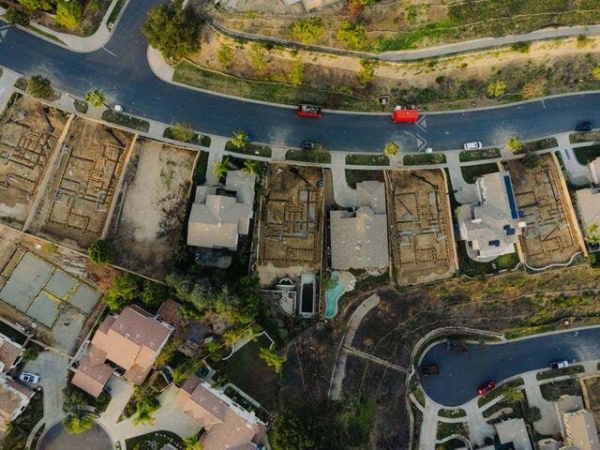
Burned lots are selling in Altadena and Pacific Palisades for half the properties’ pre-fire prices, according to Realtor.com. At least 541 lots in the Palisades — almost 14% of the burned properties — were listed for sale in 2025, with more than 200 finding buyers through September. In Altadena, 320 of 508 listings were sold through September.
The number of listings is likely to increase and prices to soften this spring as insurance payments for temporary housing run dry and more property owners acknowledge they can’t rebuild, according to Asad Khan, a Redfin senior economist. Under current state law, mortgage forbearance agreements max out after 12 months. Major banks including Wells Fargo & Co., JPMorgan Chase & Co. and Citigroup Inc. agreed this week to extend relief an additional 90 days.
Rebuilding applications so far outnumber lot sales, but construction has lagged. In Altadena, permits have been filed for more than 1,700 parcels, with at least 544 homes started or finished, according to LA County data. In Pacific Palisades, owners of roughly 1,400 of 4,500 burned lots have applied to rebuild.
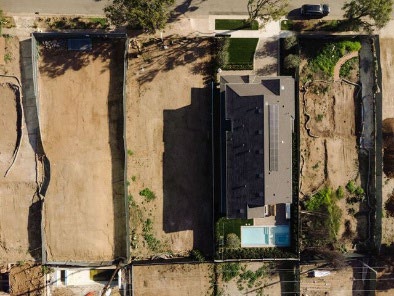
The first completed house in Pacific Palisades is a four-bedroom traditional-style home in the Alphabet Streets neighborhood, where more than 75% of structures burned. Built by Thomas James Homes, backed by private equity firm Oaktree Capital Management, the house received a certificate of occupancy in December.
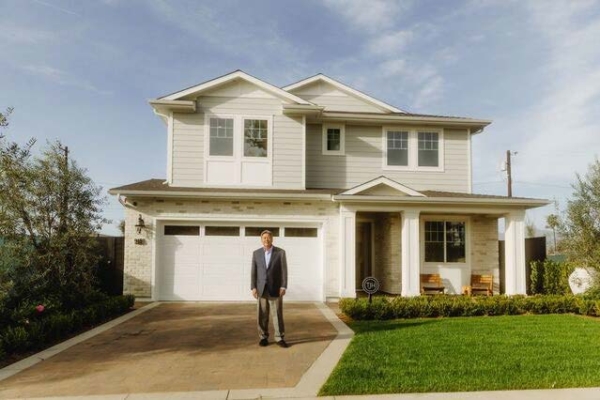

Jamie Mead, CEO of Thomas James Homes, which completed the first house in Pacific Palisades.
The new home comes with fire-resistant roofing, windows and siding; interior and exterior sprinklers; and a system to coat the structure in flame retardant foam. Construction cost about $650 a square foot, or about $2.6 million for the 4,000-square-foot house. For now, Thomas James is keeping it as a model to showcase the area’s rebirth.
“It’s a very lonely house right now, but it’s a house,” CEO Jamie Mead said in an interview. His firm, which was able to move relatively quickly because it already had permits to build in the area, plans to complete almost two dozen more houses by the end of 2026.
In Altadena, Rebecca and Jani Zandovskis are keeping up their hopes to break ground in late January on their new house. The cost is $692,000, or about $400 a square foot, a price guaranteed by Genesis Builders, Rebecca’s employer.
“If it wasn’t for that, we wouldn’t be able to rebuild,” she said.
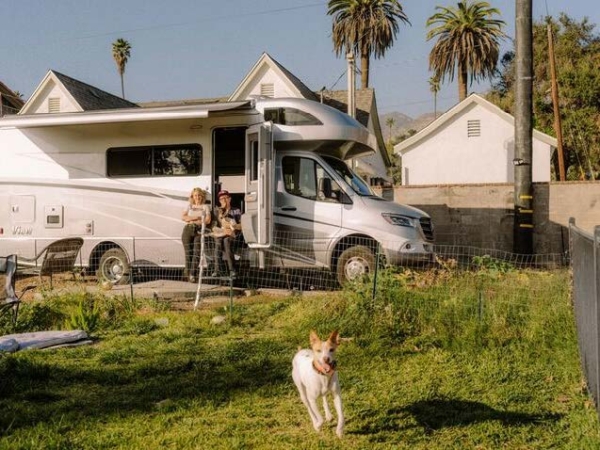
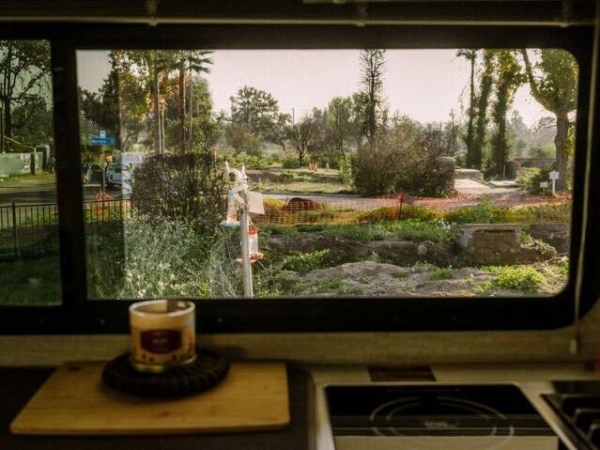

Rebecca and Jani Zandovskis live in their Winnebago RV with two rat terriers as they wait to rebuild their Altadena home.
They’re living for now in a Winnebago RV with two rat terriers, Bosco and Iggy Pop, on the burned site they bought in 2019. They took to the road in late December because their darkened street seemed like a sad place to celebrate with no house or tree to decorate.
The Zandovskis’ insurance policy covered only about $550,000 of the rebuilding costs, so they applied for a low-interest Small Business Administration loan available to disaster victims. Those loans, along with $5.7 billion in debris removal by the US Army Corps of Engineers, are among the limited federal assistance provided so far, according to Newsom. The governor, an ardent Trump critic and potential 2028 presidential contender, has pressed the president and Congress for $33.9 billion in disaster relief tied to the fires.
“Recovery requires partnership, commitment, and follow-through,” Newsom wrote in a Dec. 11 letter to Trump. “We may trade our share of political jabs, but in moments of disaster and recovery, American families expect us to work together.”
Representatives for Trump and Republican Congressional leaders didn’t respond to requests for comment.

Beachfront Bet
Some investors see an opportunity.
New Zealand billionaire brothers Mat and Nick Mowbray have spent $128 million buying 16 burned Malibu beachfront lots, betting they can roughly triple that investment by building and selling new homes.
The investment is the biggest so far by any developer in the burn areas. With an average sale projected at $25 million per home, the Mowbrays are betting prices will climb to new heights in an area known for sprawling estates owned by Larry Ellison, Marc Andreessen, Beyonce and Laurene Powell Jobs.
“Unfortunately, that’s the reality of beachfront property,” Malibu Mayor Marianne Riggins said in an interview. “It’s very limited and it’s going to be expensive.”
Nearly 600 Malibu homes burned in January — more than 10% of the city’s housing stock — the majority of them on the beach. Owners of only 140 properties have applied to rebuild.
Marcel Fontijn and Jamie Barron are planning homes for Malibu’s Carbon Beach.
The Mowbrays are still in the planning process, with the first construction likely to be completed by late 2027 if all goes well, said Marcel Fontijn, US director of operations for the Mowbrays’ firm, Zuru Group. Time is money. Every day the investment bleeds $20,000 to cover property taxes and other carrying costs.
Malibu is among the costliest places in the world to build, requiring complex engineering to anchor homes to bedrock and meet insurance and environmental requirements.
“Before you’re out of the ground, you’re easily $4 million in the hole,” Fontijn said.

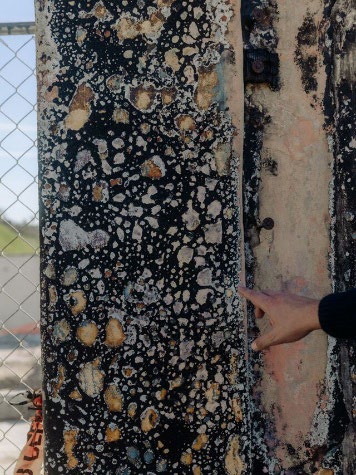
Malibu’s beaches, where 350 homes were destroyed, are still strewn with burn remnants. New construction hasn’t started in one of California’s costliest and most regulated places to build.
Critics have accused Zuru of exploiting distressed sellers, a claim Fontijn rejects, saying many owners who initially refused offers later returned as rebuilding realities set in.
“There’s only one Malibu in the world and Malibu has always attracted high-end buyers,” Fontijn said. “We don’t think they’re going to go away.”
Insurance Gaps
Zaire Calvin, a football coach and small-business owner, lost two houses when flames overtook his Altadena neighborhood. More devastatingly, his sister, Evelyn McClendon, died in the blaze. Calvin’s family has since filed a wrongful death lawsuit against SoCal Edison, alleging the company’s negligence was to blame.
No one on Calvin’s block received an evacuation alert the night of Jan. 7. He fled with his wife, 85-year-old mother and one-year-old daughter when his cousin started banging on his door at 3 a.m. As they were leaving, he saw fireballs raining down from the sky.
Zaire Calvin, who lost his sister during the fire, sits in his lot in Altadena.
“The systems in the county need to be changed so they can be equipped to handle disasters,” said Calvin, 48. “They weren’t prepared for what happened.”
In all, five homes belonging to his extended family were destroyed. Calvin received a payout of $297,000 for his recently remodeled house — a property he said would have been worth as much as $2.5 million.
Altogether, insurance companies have paid out at least $22.4 billion to residential and commercial insurance policyholders affected by the Eaton and Palisades fires, according to the California Department of Insurance. More than 42,000 claims have been filed, with most partially paid.


The view of a house under construction, and a sign Calvin posted on his lot.
Calvin’s extended family, once clustered on a single block, is now scattered across rentals hours apart. Unable to care for his disabled mother alone, he placed her in assisted living at a cost of $11,000 a month. Calvin’s own rent in Glendale is $7,000, of which insurance covers about $5,000. He continues to pay his mortgage to avoid damaging his credit and has accumulated more than $63,000 in debt.
In December, Calvin’s coverage for additional living expenses ran out. Homelessness is a real fear, he said. His situation reflects a broader strain: 48% of Eaton and Palisades fire survivors surveyed by the nonprofit Department of Angels said they have depleted a significant portion of their savings, and 43% reported taking on debt.
Still, Calvin says he has never considered selling. Shortly after the disaster, he testified before a state Assembly committee in support of legislation to protect fire survivors from unsolicited offers by real estate developers. The bill passed.
“It’s the only place I know,” he said. “I’ve loved my community, worked in my community, and I’m connected to thousands of people there. It was never even a thought.” —With Courtney Subramanian, Caitlin Reilly and Ainsley Thomson